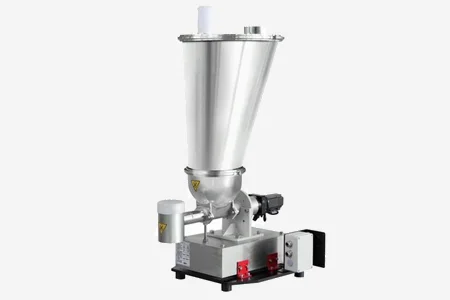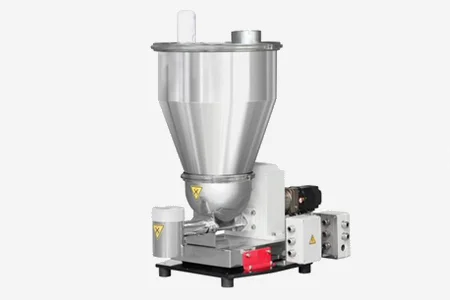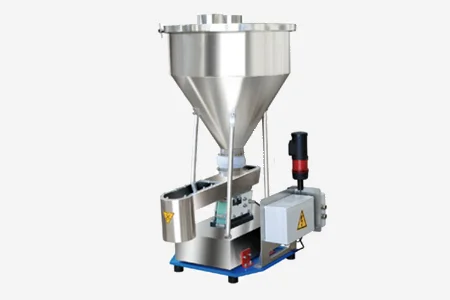

Three Load Cell Loss in Weight Feeder
With three-point suspension load cell, the center of gravity of the Three Load Cell Loss in Weight Feeder is lower than three fulcrums, the overall structure is stable, and a larger volume hopper can be configured, the feeding cycle can be prolonged, and the feeding times can be reduced, it is suitable for large-output feeding demand.
Three load cell loss in weight feeder is designed to provide single feedback feeding control technology. It has improved the PLC signal acquisition, the speed, the response, the accuracy and stability of feeder. The feeding parts can be easily installed and disassembled, and easy to clean, replace and maintain.
A horizontal agitator can work with an optional vertical agitator to prevent poor flowing powders that tend toward bridging. Many models adopt the same screw interface, so different screws can be easily installed and disassembled to realize a broader feeding rate by one feeder.
Three load cell loss in weight feeder can be widely applied to chemical industry, rubber & plastic, cable, new energy, building materials, etc. Three load cell loss in weight feeder adopts the same control method as other loss in weight feeders and feed accuracy can reach ±0.5%. All material contact parts are stainless steel.

Three load cell loss in weight feeder - Benefits
Prevent bridging
Corrosion resistance
Easy to clean
Stability
Accuracy
Sealing
Three Load Cell Loss in Weight Feeder
Technical Specification
| Model | Feed rate (kg/h) | Motor | Material of contacted parts | Material of seal | Symmetric hopper (L) |
|---|---|---|---|---|---|
| TLW-3ST46 | TLW-3ST64 | ||||
| 400-1500 | 600-2500 | ||||
| 1.5KW, AC 380V, 3Ph, IP55 | 2.2KW, AC 380V, 3Ph, IP55 | ||||
| 304 stainless steel | 304 stainless steel | ||||
| Silicon rubber/Nitrile-butadiene rubber/PTFE | Silicon rubber/Nitrile-butadiene rubber/PTFE | ||||
| 300 | 400 |
Three load cell loss in weight feeder
The three load cell configuration offers several advantages over single or dual load cell systems. By distributing the load cells evenly, it provides better weight distribution and minimizes the risk of inaccurate readings caused by uneven weight distribution or external forces. This results in improved weighing accuracy and a more reliable feeding process.
The loss-in-weight feeder is particularly useful in applications where precise ingredient dosing is essential. It is commonly used in industries such as food processing, pharmaceuticals, plastics, and chemicals, where precise control over material flow and dosing is critical to achieving desired product quality and consistency.
The three load cell loss-in-weight feeder is also known for its versatility. It can handle a wide range of bulk materials, including powders, granules, pellets, and more. The system can be easily programmed to accommodate different feed rates, feed durations, and material characteristics, allowing for flexibility in various production processes.
Additionally, this feeder is equipped with advanced control systems that enable seamless integration into existing production lines. It can be synchronized with other equipment, such as mixers or extruders, to ensure smooth material flow and optimize overall process efficiency.
Maintenance and calibration of the three load cell loss-in-weight feeder are relatively straightforward. The load cells can be easily accessed, and calibration routines can be performed periodically to ensure accurate weighing. Regular maintenance and cleaning of the feeder help to prevent material build-up and ensure consistent performance.
Frequently Asked Questions
A Three Load Cell Loss in Weight Feeder is a gravimetric feeding system that continuously measures material weight loss using three load cells to deliver highly accurate and consistent feeding.
The feeder continuously monitors the hopper weight with three load cells and automatically adjusts the screw speed to maintain the required feed rate as material is discharged.
A Three Load Cell Loss in Weight Feeder provides better weight distribution, improved stability, higher accuracy, and more reliable measurements, especially with larger hoppers.
It can accurately feed powders, granules, pellets, flakes, and other bulk materials used in industrial processing.
Most Three Load Cell Loss in Weight Feeders achieve feeding accuracy of up to ±0.5%, depending on the material and operating conditions.
These feeders are widely used in the chemical, plastics, rubber, food, pharmaceutical, cable, battery, and building materials industries.
Yes. Optional horizontal and vertical agitators help prevent bridging and ensure consistent feeding of difficult or cohesive powders.
Yes. Different screw sizes and hopper capacities can be easily installed, allowing one Three Load Cell Loss in Weight Feeder to cover a wide range of feeding capacities.
Yes. The feeding components are designed for quick disassembly, making cleaning, maintenance, and screw replacement simple and efficient.
Key benefits include high weighing accuracy, stable operation, large hopper capacity, fewer refill cycles, easy maintenance, and seamless integration with PLC-based production systems.