
Powder Classification Sieve for Accurate Grading
The Powder Classification Sieve is designed to accurately separate powders and granules into homogeneous particle size fractions, ensuring consistent product quality and optimized downstream processing.
Classification enables a single bulk material to be divided into one or more well-defined size ranges, each tailored for specific production requirements or end-use applications. Available with up to four screening decks, the system delivers precise, continuous particle size separation while maximizing throughput and screening efficiency.
It is ideal for applications requiring tight particle size control in the food, chemical, pharmaceutical, plastics, minerals, recycling, and additive manufacturing industries, helping manufacturers improve process performance, reduce off-spec products, and achieve reliable, repeatable production results.
Powder Classification Sieve - Models
Our Powder Classification Sieves are available in multi-deck vibrating, tumbler, and multifrequency configurations to suit different capacities and material characteristics. From fine powders to high-volume bulk materials and difficult-to-screen products, each model delivers accurate multi-fraction separation with reliable performance.
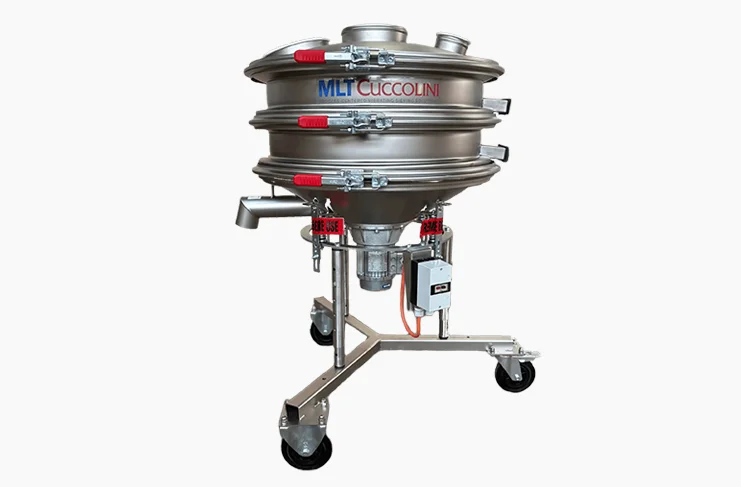
Multi-deck Powder Classification Screener
Designed for moderate-capacity powder classification, the Multi-deck vibrating series features up to four screening decks for accurate multi-fraction separation. Its compact design and adjustable mesh sizes make it ideal for flexible classification applications up to approximately 10 t/h, depending on the material.
- Up to four screening decks
- Approx. capacity up to 10 t/h*
- Good fit for flexible, moderate-capacity duties

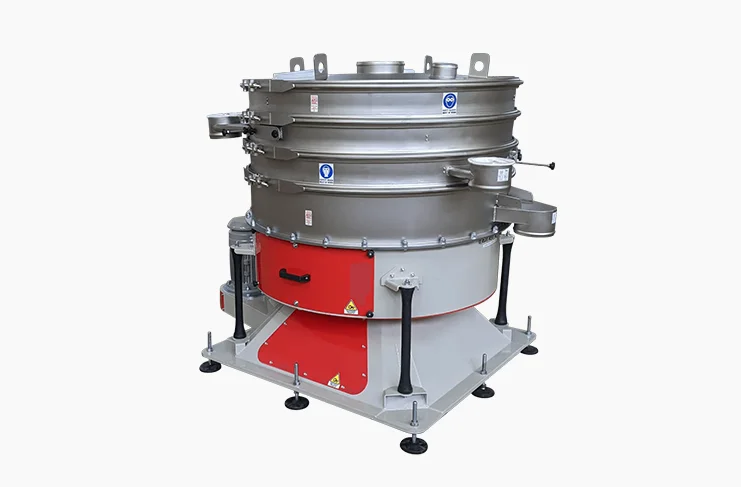
Tumbler Powder Classification Sieve
Designed for high-capacity powder classification, the Tumbler Powder Classification Sieve provides accurate multi-fraction separation with up to four screening decks. Its large screening area makes it ideal for processing bulk materials at capacities up to approximately 50 t/h while maintaining precise classification accuracy.
- Up to four screening decks
- Approx. capacity up to 50 t/h*
- Suited to higher-volume bulk classification

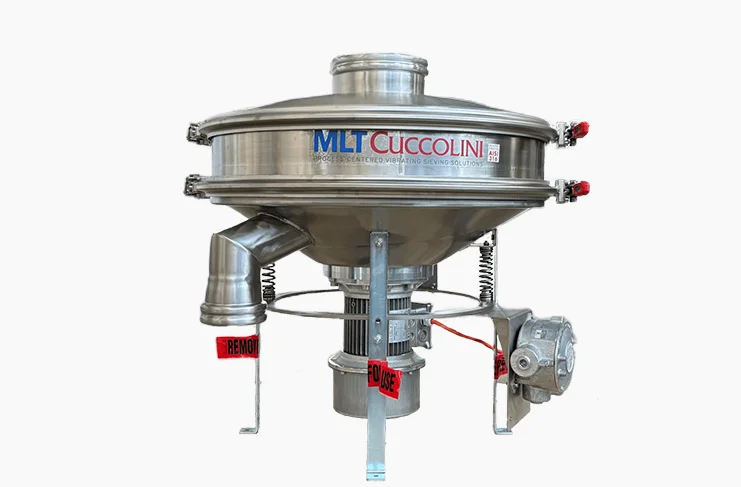
Multifrequency Powder Classification Sieve
Designed for difficult-to-screen powders, such as cohesive, fatty, or hygroscopic materials, this multifrequency classification sieve delivers accurate separation while minimizing mesh blinding. With up to two screening decks, it provides reliable classification and consistent performance for challenging applications at capacities up to approximately 5 t/h, depending on the material.
- Challenging powder
- Approx. capacity up to 5 t/h*
- Designed to reduce blinding risk
Powder Classification Sieve - Benefits
Using a Powder Classification Sieve improves particle size consistency, increases production efficiency, reduces waste, and helps deliver high-quality products with reliable and repeatable classification results.
Improve Product Consistency −
Produces uniform particle size distributions for consistent product quality.
Increase Process Efficiency +
Reduce Product Waste +
Enhance Production Quality +
Maximize Throughput +
Lower Operating Costs +
Easy to Maintain +
Suitable for Multiple Industries +
Powder Classification Sieve - Features
Using a Powder Classification Sieve improves particle size consistency, increases production efficiency, reduces waste, and helps deliver high-quality products with reliable and repeatable classification results.
- Multi-Deck ScreeningSeparates materials into multiple size fractions.
- High Screening AccuracyDelivers precise and consistent particle classification.
- Wide Mesh SelectionSupports various mesh sizes for different applications.
- Automatic Mesh CleaningMaintains screening efficiency with minimal downtime.
- Stainless Steel ConstructionProvides hygienic, durable, and corrosion-resistant performance.
- Continuous OperationDesigned for reliable 24/7 industrial use.
- Customizable DesignAvailable in multiple sizes and configurations.
- Easy System IntegrationIntegrates with conveying, mixing, and packaging lines.
Frequently Asked Questions
A Powder Classification Sieve is an industrial vibrating screening machine that separates powders into two or more particle size fractions. It provides accurate particle size classification to produce consistent, high-quality products for industrial applications.
A Powder Classification Sieve uses one or multiple mesh screens and controlled vibration to separate particles according to their size. Larger particles remain on the upper screens, while finer particles pass through to lower decks, producing multiple accurately graded fractions.
A Powder Safety Sieve removes contaminants and oversized particles before processing, while a Powder Classification Sieve separates powders into different particle size ranges to meet product specifications and improve process consistency.
Powder Classification Sieves are widely used in the food, pharmaceutical, chemical, battery materials, additive manufacturing, plastics, ceramics, minerals, and metal powder industries where precise particle size distribution is essential.
A Powder Classification Sieve can classify a wide range of dry materials, including flour, sugar, cocoa powder, spices, chemicals, pigments, calcium carbonate, metal powders, minerals, ceramics, plastic granules, and pharmaceutical ingredients.
Yes. Multi-deck Powder Classification Sieves can separate a single product into two, three, or more particle size fractions in one continuous operation, improving production efficiency and reducing processing time.
The ideal mesh size depends on your required particle size distribution, product characteristics, and production capacity. Material testing is recommended to determine the optimum screen configuration for accurate and efficient classification.
Yes. Modern Powder Classification Sieves are available with advanced vibration technology and automatic mesh-cleaning systems to efficiently classify fine, cohesive, or difficult-to-screen powders while minimizing mesh blinding.
A Powder Classification Sieve improves product consistency, increases process efficiency, enhances particle size control, reduces waste, supports quality standards, and helps achieve reliable downstream processing.
When selecting a Powder Classification Sieve, consider your powder characteristics, required particle size distribution, throughput, number of product fractions, hygiene requirements, installation space, and process integration. Product testing is recommended to ensure the best classification performance.