

Vibrating Sieving for Pharmaceutical APIs and Ingredients
Active pharmaceutical ingredients (APIs), excipients, and other functional powders used in human and veterinary medicines require carefully controlled particle size and effective removal of foreign material. Vibrating sieving provides an important quality-control step, helping pharmaceutical manufacturers achieve consistent powders while supporting hygienic processing, containment, and reliable downstream production.
Controlling Pharmaceutical Powder Quality
Pharmaceutical powders and microgranules can pass through several processing stages, including crystallization, drying, granulation, and milling. During these operations, agglomerates, oversized particles, or unwanted foreign material may be introduced into the product.
Before powders proceed to critical stages such as blending, tablet compression, encapsulation, or filling, safety sieving can be used to remove these unwanted materials. This provides an additional level of product protection while helping prevent equipment problems and quality deviations in subsequent processing.
The required screening solution depends on the characteristics of the powder, required cut size, production capacity, installation point, and level of containment required.
Safety Sieving and Particle Size Classification
Pharmaceutical screening applications generally involve two primary objectives: safety sieving and particle size classification.
Safety sieving removes foreign material, agglomerates, and particles outside the acceptable size range before further processing. Classification, on the other hand, separates material according to defined particle-size ranges.
Accurate classification can be particularly important for APIs and excipients used in solid dosage forms because particle size distribution can influence powder flowability, bulk density, compressibility, blending behaviour, and dissolution characteristics.
Properly configured vibrating sieves can perform either function and, where required, can separate a product into multiple fractions.
In-Line Sieving for Pneumatic Conveying
Where pharmaceutical powders are transferred through a closed pneumatic conveying system, an in-line sieve can be incorporated directly into the conveying route.
Pharmaceutical versions of in-line vibrating sieves can remove oversized particles and foreign material while maintaining enclosed product transfer. This approach is particularly useful where minimizing product exposure to the surrounding environment and limiting operator contact are important process considerations.
Integrating screening directly into the transfer system can also eliminate the need for an additional open handling step between processes.
Sieving for Gravity-Fed and Batch Processes
Many pharmaceutical applications require screening below silos, sack-tip stations, feeding systems, or directly above process vessels.
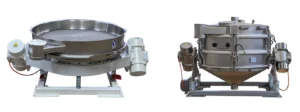
For these installations, pharmaceutical versions of circular vibrating sieves, compact solutions for safety screening and classification.
Controlled vibration moves the powder across the screening surface while allowing the required fraction to pass through the selected mesh. The equipment can therefore be configured according to the powder characteristics and required separation point while providing gentle handling of sensitive materials.
Fine Powder and Multi-Fraction Classification
Some pharmaceutical processes require more precise separation of fine powders or classification into multiple particle-size fractions.
Multifrequency rectangular vibrating sieves, can be adapted for pharmaceutical applications involving demanding fine powders. Depending on the process requirements, these systems can be configured with single or multiple screening decks, allowing several particle-size fractions to be separated within one machine.
Appropriate equipment configuration can also help address processing challenges associated with difficult powders, including electrostatic behaviour and reduced screening efficiency.
Hygienic Design and Containment
Equipment used for pharmaceutical powders must be designed with cleaning, product changeover, contamination control, and operator protection in mind.
Depending on the application, pharmaceutical vibrating sieves can incorporate features such as:
- AISI 316 stainless steel product-contact parts
- Mirror-polished product-contact surfaces
- Tri-Clamp and BFM connections
- Designs that minimize difficult-to-clean areas and product retention
- Rapid assembly and disassembly for cleaning and inspection
- Sealed configurations for enhanced powder containment
- Solutions for applications with specific OEB requirements
- ATEX configurations where required by the area and product classification
These features help integrate the sieving stage into pharmaceutical processes where hygiene, cleanability, containment, and controlled product handling are critical.
Selecting the Right Pharmaceutical Vibrating Sieve
There is no single screening configuration suitable for every pharmaceutical powder. Equipment selection should consider the properties of the API or ingredient, particle size distribution, required cut point, throughput, installation location, cleaning procedure, containment requirements, and upstream and downstream processes.
The availability of in-line, circular, and rectangular screening technologies makes it possible to integrate sieving at different points throughout a pharmaceutical production facility.
Tiermax Pharmaceutical Sieving Solutions
Tiermax provides vibrating sieving and classification solutions for APIs, excipients, and other pharmaceutical ingredients, including pharmaceutical screening technologies from MLT Cuccolini.
Solutions can be developed for in-line safety screening, gravity-fed applications, batch processing, fine powder classification, and multi-fraction separation, with configurations selected according to the specific requirements of each process.
By integrating the appropriate vibrating sieve into the production line, pharmaceutical manufacturers can achieve more consistent particle size, effective removal of unwanted material, improved protection of downstream equipment, and more reliable powder processing while addressing demanding hygiene and containment requirements.
Contact Tiermax to discuss your pharmaceutical powder application. Our team can review your product characteristics, required particle size, throughput, installation point, and containment requirements to identify a suitable vibrating sieving and classification solution.

Let's discuss your project
Our team of experts are ready to help find you solutions tailored to your specific needs.
Related Products

Powder Classification Sieve for Accurate Grading
The Powder Classification Sieve is designed to accurately separate powders and granules into homogeneous particle size fractions, ensuring…
read more ›
Powder Safety Sieve
A Powder Safety Sieve is a high-performance vibrating screening system designed to remove oversized particles, foreign contaminants, and…
read more ›
Dedusting Sieve
A Dedusting Sieve is a high-performance vibrating screening system that removes unwanted fine particles and dust from powders…
read more ›Frequently Asked Questions
Safety sieving helps remove agglomerates, oversized particles, and foreign materials before powders enter critical stages such as blending, tablet compression, encapsulation, or filling. This supports consistent product quality while helping protect downstream processing equipment.
Safety sieving is primarily used to remove unwanted or oversized material from the product stream. Classification separates powders into defined particle-size ranges. For APIs and excipients, controlled particle size distribution can contribute to consistent flowability, bulk density, compressibility, blending behaviour, and dissolution performance.
Vibrating sieves can be integrated at several process points, including below silos and sack-tip stations, after milling or granulation, above mixers or process vessels, and within closed pneumatic conveying systems. The optimum location depends on where particle-size control or protection against foreign material is required.
Depending on the application, important features can include AISI 316 stainless steel product-contact parts, polished surfaces, easy-to-clean construction, quick-release connections, reduced product-retention areas, and sealed configurations. For potent or sensitive powders, the system can also be selected according to specific containment and OEB requirements, with ATEX execution considered where applicable.
Selection should consider the particle size distribution, required cut point, powder flow characteristics, throughput, installation point, hygiene requirements, containment level, cleaning procedure, and upstream/downstream equipment. For difficult, fine, cohesive, or electrostatically sensitive powders, testing with representative material can help confirm the appropriate mesh and operating configuration.