

Alcohol Recovery During Alcoholic Beverage Production
Alcohol recovery is an important process in distilleries and beverage production, particularly when alcohol is used during the distillation or maceration of botanicals, fruits, herbs, and other plant-based ingredients. These processes can leave fine plant particles, fibres, and other suspended solids in the recovered alcohol.
Efficient solid-liquid filtration with vibrating sieves provides a practical way to remove these contaminants before the alcohol is stored, reused, or transferred to another processing stage.

Why Filter Recovered Alcohol?
Alcohol streams recovered from distillation and maceration may contain suspended organic material that can affect downstream processing and make storage, cleaning, and alcohol reuse more difficult.
Traditionally, these solids may be separated through gravity settling or decantation, requiring storage tanks and sufficient residence time for particles to settle.
A properly selected vibrating sieve provides an alternative approach by continuously separating suspended solids from the liquid stream. This can reduce dependence on long settling periods and allow recovered alcohol to move more efficiently through the process.
Reducing Decantation Time and Tank Requirements
One of the main advantages of vibrating filtration is the potential to reduce or, in suitable applications, eliminate dedicated decantation stages.
Rather than holding alcohol in large tanks while solids settle naturally, the liquid can be screened directly after the relevant processing stage. This can help:
- Reduce settling and residence time
- Minimize required decantation tank volume
- Recover alcohol more efficiently
- Reduce material handling between process stages
- Lower the solid load entering downstream equipment
- Optimize available production space
Reducing the number and size of intermediate tanks may also contribute to lower CAPEX and OPEX, depending on the overall process arrangement.
How Vibrating Sieving Works for Alcohol Recovery
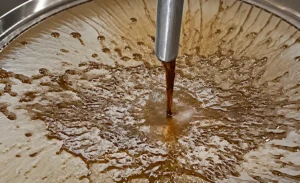
For relatively low-viscosity liquids such as ethanol-rich process streams, a circular vibrating sieve can be installed directly within the production line.
Controlled vibration encourages the liquid phase to pass through the selected screen mesh while retained solids are continuously moved toward a separate discharge point.
This provides a compact and continuous separation process without relying solely on gravity settling.
The final configuration should be selected according to parameters such as:
Required filtration level: The target clarity determines the appropriate mesh opening.
Flow rate: Screening area and machine size should accommodate the required liquid capacity.
Solids concentration: The quantity of suspended material affects sieve configuration and discharge requirements.
Particle characteristics: Fibres, botanical particles, fruit residues, and other solids can behave differently during screening.
Installation point: The sieve should be positioned where solids can be efficiently removed without unnecessarily interrupting the process.
AISI 316 Stainless Steel for Product Contact
Alcohol-containing streams require careful consideration of equipment materials.
For demanding beverage applications, product-contact components can be manufactured from AISI 316 stainless steel, providing good corrosion resistance and supporting the cleaning and sanitation requirements commonly found in beverage-processing facilities.
A hygienic, accessible design also facilitates inspection and cleaning between different production batches or recipe changes.
ATEX Considerations for Alcohol Processing
Alcohol vapours can create a potentially flammable atmosphere. When equipment is installed in a hazardous classified area, its design must therefore reflect the applicable area classification and safety requirements.
Vibrating sieves can be supplied in suitable ATEX gas executions for installations where flammable vapours may be present.
The required hazardous-area classification should always be confirmed during engineering so that motors, electrical components, instrumentation, grounding, and other relevant components are correctly specified.
Typical Installation Points
Vibrating sieves for alcohol recovery can be integrated at different stages depending on the plant configuration. Typical locations include:
- Downstream of distillation equipment
- After botanical or fruit maceration
- At intermediate alcohol collection tanks
- Before recovered alcohol storage
- Before alcohol is returned to the production process
- Where alcohol is separated from spent botanical material
The compact footprint of circular vibrating sieves can make them particularly suitable for installation close to existing tanks, piping, and processing equipment.
Benefits of Vibrating Sieves for Alcohol Recovery
Continuous Filtration
Separate suspended solids directly from the alcohol stream without relying entirely on gravity settling.
Reduced Decantation
Minimize lengthy settling stages and potentially reduce the number or size of intermediate tanks.
Improved Alcohol Recovery
Prepare valuable recovered alcohol streams for reuse or further processing.
Compact Installation
Integrate filtration into existing distillation and beverage-processing lines with limited space requirements.
Corrosion-Resistant Construction
AISI 316 stainless-steel product-contact parts can be specified for demanding alcohol-processing environments.
Hazardous-Area Configuration
ATEX-compatible executions can be provided according to the classified-area requirements of the installation.
TIERMAX Alcohol Filtration Solutions
TIERMAX provides vibrating sieving and solid-liquid filtration solutions for distilleries and beverage-processing plants, helping separate botanical particles, fibres, and process residues from recovered alcohol streams.
Each system can be configured according to the required flow rate, solids loading, target filtration level, mesh size, product characteristics, installation layout, cleaning requirements, and hazardous-area classification.
By integrating the appropriate vibrating sieve into the recovery process, producers can reduce dependence on conventional decantation, improve alcohol reuse, simplify solids removal, and create a more compact and efficient production process.

Let's discuss your project
Our team of experts are ready to help find you solutions tailored to your specific needs.