

Zinc Oxide Sieving: Improving Product Purity and Particle Size Control
Zinc oxide is widely used across industrial, chemical, cosmetic, pharmaceutical, and other high-value applications. In many of these processes, consistent particle size, product purity, and reliable powder handling are essential to achieving the required final-product quality.
Because fine zinc oxide powders can form agglomerates during production, storage, or handling, an effective sieving process can play an important role in maintaining product specifications and protecting downstream equipment.
Why Is Sieving Important for Zinc Oxide?
During processing and material handling, zinc oxide powder may contain agglomerates, oversized particles, or foreign contaminants. These can negatively affect powder flowability, dispersion, downstream processing, and final product consistency.
Industrial vibrating sieves can be integrated at different stages of the production line to perform two main functions:
Safety Sieving
Removes foreign material and oversized particles before the powder enters sensitive downstream equipment or production stages.
Particle Classification
Separates zinc oxide according to the required particle-size range, helping manufacturers achieve a more controlled and consistent final product.
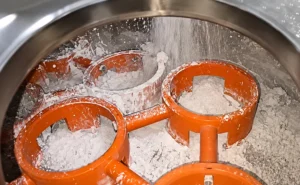
Safety Sieving for Process Protection
Safety sieving is commonly installed at critical powder transfer points, such as below silos, sack tipping stations, feeding systems, or before downstream processing equipment.
The objective is to provide a final control step that intercepts unwanted particles and contaminants before they continue through the process.
This can help:
- Improve final product purity
- Protect downstream equipment
- Remove oversized particles
- Reduce contamination risks
- Maintain consistent production quality
- Improve overall process reliability
Classification of Fine Zinc Oxide Powder
When tighter particle-size control is required, vibrating sieves can also be used for fine powder classification.
Depending on the powder characteristics, required capacity, mesh size, and machine configuration, zinc oxide can be classified into precisely controlled fractions. Properly configured industrial screening systems can achieve classification even at particle sizes below 100 microns.
This capability is particularly important where a narrow and consistent particle-size distribution is required.
Recovering Product from Agglomerates
Not every oversized zinc oxide particle needs to become waste.
Some oversized material consists of agglomerated fine particles rather than genuinely oversized individual particles. With an appropriate screening and mesh-cleaning system, these agglomerates can be gently broken apart during the sieving process.
The recovered fine particles can then pass through the screen and return to the acceptable product fraction. This approach can help increase product recovery while reducing unnecessary material losses.
Where Can Zinc Oxide Sieves Be Installed?
Vibrating sieves can be integrated at several locations within a powder processing system, including:
- Below storage silos
- At sack tipping stations
- After milling
- After blending or mixing
- Along pneumatic or mechanical conveying lines
- Before packaging
- Before sensitive downstream equipment
- At final product quality-control points
Selecting the correct location depends on whether the main objective is safety screening, classification, product recovery, or downstream equipment protection.
Selecting the Right Sieving System
There is no single sieve configuration suitable for every zinc oxide application. Selection should consider:
- Required particle or cut size
- Powder particle-size distribution
- Required throughput
- Bulk density
- Agglomeration tendency
- Number of required fractions
- Product-contact material
- Cleaning requirements
- Installation location
- Available space and connection arrangement
- Applicable hygienic or process requirements
For sensitive applications, stainless-steel construction and easy-cleaning designs can also support product cleanliness and efficient maintenance.
Integrated Sieving Solutions
TIERMAX provides industrial sieving and powder-handling solutions that can be integrated with upstream and downstream equipment to create a complete processing system.
Depending on the application, the sieving equipment can be combined with sack tipping stations, bulk bag unloading systems, pneumatic conveying, feeders, mixers, mills, storage equipment, and packaging systems.
By evaluating the complete material flow rather than the sieve alone, the system can be configured to improve product quality, minimize powder losses, and maintain reliable material transfer throughout the process.
Conclusion
Effective zinc oxide sieving is more than simply separating large and small particles. A properly selected system can provide contamination control, safety screening, precise classification, agglomerate recovery, and protection of downstream processes.
For applications requiring fine particle control, the combination of suitable vibration technology, screen mesh, mesh-cleaning system, and process configuration is essential for achieving consistent and efficient separation.

Let's discuss your project
Our team of experts are ready to help find you solutions tailored to your specific needs.
Related Products

Powder Safety Sieve
A Powder Safety Sieve is a high-performance vibrating screening system designed to remove oversized particles, foreign contaminants, and…
read more ›
Powder Classification Sieve for Accurate Grading
The Powder Classification Sieve is designed to accurately separate powders and granules into homogeneous particle size fractions, ensuring…
read more ›
Dedusting Sieve
A Dedusting Sieve is a high-performance vibrating screening system that removes unwanted fine particles and dust from powders…
read more ›Frequently Asked Questions
Safety sieving removes foreign contaminants, agglomerates, and oversized particles before the powder reaches sensitive downstream processes, helping maintain product quality and protect equipment.
Yes. With the appropriate sieve configuration, mesh, and operating parameters, high-efficiency classification below 100 μm can be achieved for demanding fine-powder applications.
Suitable mesh-cleaning and vibration systems can gently break down agglomerates, allowing usable fine particles to pass through the screen and return to the acceptable product fraction. This helps reduce product waste.
Vibrating sieves can be installed below silos, at sack tipping or feeding stations, along conveying lines, or after milling and blending, depending on whether the objective is safety screening or particle classification.
Selection depends on factors such as target particle size, required throughput, powder characteristics, installation point, cleaning requirements, and plant layout. Mesh size and vibration parameters should be configured for the specific application.