

Construction Materials Bagging Line – Built for Abrasive Products
High-Performance Bagging for Abrasive Construction Materials
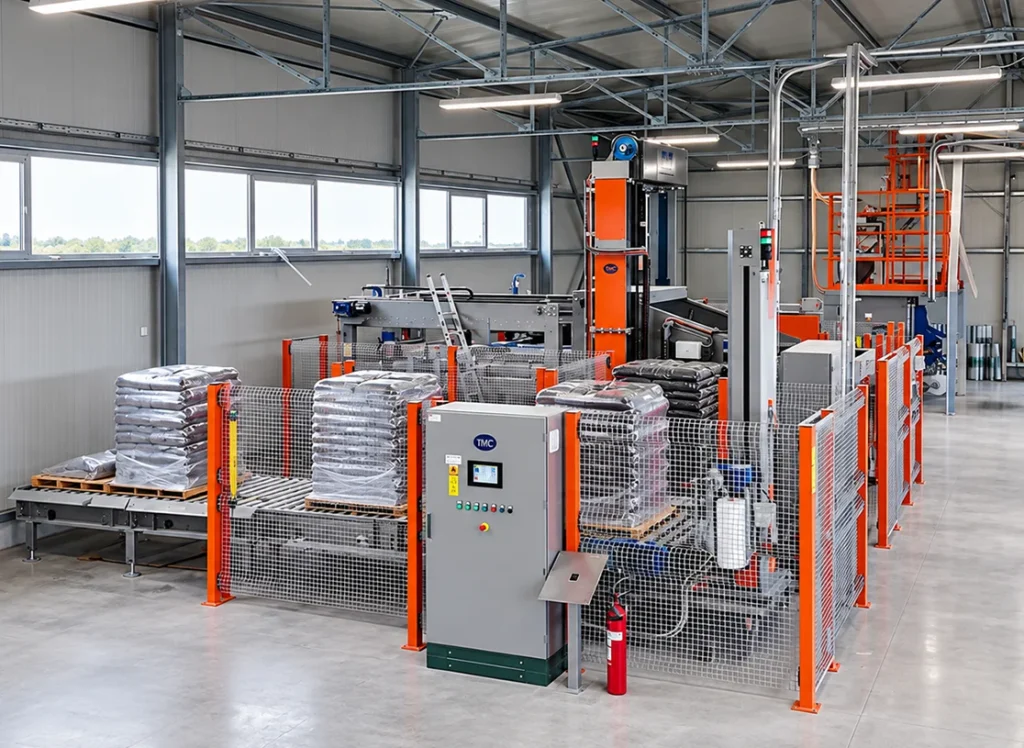
A complete automated packaging line demonstrates how abrasive construction materials such as sand, gravel, and pebbles can be efficiently bagged, palletized, and wrapped while addressing the challenges of wear, dust, and continuous operation.
The solution was developed by MF TECNO, TIERMAX’s technology partner for packaging and palletizing systems, with equipment specifically configured for demanding abrasive products.
The Challenge
High-throughput packaging of abrasive materials creates continuous wear on product-contact components. Moisture and repeated impact can further increase mechanical stress and shorten equipment service intervals.
Fine dust presents another challenge. If dust reaches the sealing area, it can interfere with heat sealing and affect bag integrity.
The objective was therefore not only to achieve the required production rate, but to maintain consistent bag quality and reliable operation over extended production runs.
A Packaging Line Designed for Abrasive Materials
The complete solution combines:
- Vertical Form-Fill-Seal (VFFS) bagging system
- Reinforced product-contact components
- Elastomeric linings for high-wear areas
- Anti-wear hopper coating
- Reinforced cross-sealing system
- Dust extraction before the sealing station
- Automatic push palletizer
- Automatic stretch wrapper
The bagging system incorporates targeted wear protection in areas exposed to continuous product contact, helping extend component life and reduce maintenance requirements.
Dust Control & Reliable Bag Sealing
Fine dust can accumulate around the sealing area and prevent a clean, uniform seal.
To address this, a dedicated dust extraction system is positioned before the heat-sealing station, helping remove airborne particles before the bags are sealed.
This helps maintain consistent seal quality and reduces the potential for leaks during palletizing, storage, and transportation.
Automated Palletizing & Wrapping
After filling and sealing, bags are automatically transferred to a push palletizer, where they are arranged into stable pallet patterns.
The completed pallets then move to an automatic stretch wrapper, providing secure load containment and preparing the finished product for storage and shipment.
The Result
The complete line achieves production rates of up to 1,000 bags per hour, with daily production of up to 8,000 bags and approximately 265 short tons per day.
The application demonstrates several important benefits:
- Reliable packaging of highly abrasive materials
- Reduced wear on critical equipment components
- Improved seal integrity through effective dust control
- Easier access to wear components for maintenance
- Automated bagging, palletizing, and wrapping
- Consistent performance during extended production runs
For similar applications, TIERMAX can integrate packaging and end-of-line automation around the specific characteristics of the material, required production capacity, bag format, and operating conditions.

Let's discuss your project
Our team of experts are ready to help find you solutions tailored to your specific needs.
Related Products

Vertical packaging machine
The vertical packaging machine for large bags (VFFS) is the ideal solution for automatically forming, filling and closing…
read more ›
Bulk Bag Filling System
TiERMAX offers the best solutions for the bulk bag filling system based on your application, desired filling capacities…
read more ›
Form Fill Seal bagging machine
Our Form Fill Seal bagging machine (FFS) was created to manage the packaging of free-flowing, powdery and granular…
read more ›Frequently Asked Questions
The system can be configured for abrasive construction and mineral products such as sand, gravel, pebbles, aggregates, and similar bulk materials. Equipment configuration should be selected according to material characteristics such as particle size, abrasiveness, moisture content, bulk density, and required production capacity.
High-wear product-contact areas can be protected using elastomeric linings, wear-resistant coatings, reinforced components, and other material-specific protection. Easy access to wear components is also important because it can simplify preventive maintenance and reduce the time required for component replacement.
Fine particles can accumulate in the sealing area and interfere with the formation of a uniform heat seal. Integrating dust extraction before the sealing station helps keep the sealing surfaces cleaner and improves bag seal consistency.
Capacity depends on the product, bag size, feeding method, and equipment configuration. In this application, the line operates at up to 1,000 bags per hour, with production of up to 8,000 bags per day.
Wear cannot be completely eliminated when handling highly abrasive products. For this reason, equipment layout and component accessibility are important considerations. Designing the system so that high-wear components can be inspected and replaced without extensive disassembly can help shorten maintenance interventions and reduce unplanned production interruptions.